
Organic Acids Education
Organic Acids Test Interpretive Guide
A Practical Guide to Connecting OAT Markers With Biochemistry
Organic Acids Tests provide much more information than isolated high and low values. The real value comes from understanding how markers connect to biochemical pathways, nutrient cofactors, mitochondrial energy production, amino acid metabolism, detoxification, and microbial activity.
This guide is designed to help practitioners move beyond individual markers and begin recognizing the biochemical relationships behind common OAT patterns.
Created by Dr. Gail Clayton, DCN, CNS, MS, RPh, LDN
Download the Organic Acids Test Interpretive Guide
Keep this quick-reference guide handy as you review Organic Acids Test results. It summarizes key markers, pathways, nutrient cofactors, mitochondrial patterns, fatty acid oxidation clues, detoxification markers, and microbial considerations in an easy-to-scan format.
Use it alongside the full interpretive page whenever you want a concise clinical reference.
Section 1
B-Vitamin & Amino Acid Markers
These markers reflect the breakdown of the branched-chain amino acids (valine, leucine, and isoleucine) and tryptophan. Each step depends on vitamin cofactors, so an elevation is a prompt to ask which pathway is involved and which cofactors that pathway requires.
α-Ketoisovalerate
Valine metabolism
What an elevation may suggest
Reduced clearance of the valine-derived keto acid through valine catabolism.
Pathway
Valine catabolism
Nutrients / cofactors to consider
B-complex vitamins; lipoic acid
α-Ketoisocaproate
Leucine metabolism
What an elevation may suggest
Reduced clearance of the leucine-derived keto acid through leucine catabolism.
Pathway
Leucine catabolism
Nutrients / cofactors to consider
B-complex vitamins; lipoic acid
α-Keto-β-methylvalerate
Isoleucine metabolism
What an elevation may suggest
Reduced clearance of the isoleucine-derived keto acid through isoleucine catabolism.
Pathway
Isoleucine catabolism
Nutrients / cofactors to consider
B-complex vitamins; lipoic acid
The three branched-chain keto acids above share the same cofactor considerations, so it is worth checking whether they are moving together.
Alpha-ketoglutarte may also be elevated because it also share the same cofactor considerations as the alpha-keto acids.
Kynurenate
Tryptophan metabolism · Vitamin B6
What an elevation may suggest
Altered tryptophan catabolism with a possible Vitamin B6 relationship. A low ALT on conventional labs (below 11) is a related clue that may point in the same B6 direction.
Pathway
Tryptophan catabolism (hepatic)
Nutrients / cofactors to consider
Vitamin B6
β-Hydroxyisovalerate
Biotin-related metabolism
What an elevation may suggest
A biotin-related bottleneck in leucine catabolism.
Pathway
Leucine catabolism / biotin-related metabolism
Nutrients / cofactors to consider
Biotin; magnesium
Methylmalonate
Vitamin B12-related metabolism
What an elevation may suggest
A Vitamin B12-related bottleneck in the breakdown of valine or odd-chain fatty acids.
Pathway
Valine or odd-chain fatty acid catabolism
Nutrients / cofactors to consider
Vitamin B12
Section 2
Fatty Acid Oxidation
Adipate, suberate, and ethylmalonate are markers of fatty acid oxidation. When they rise, the question becomes how efficiently fatty acids are being carried into the mitochondria and oxidized for energy, and whether the cofactors that process depends on are available.
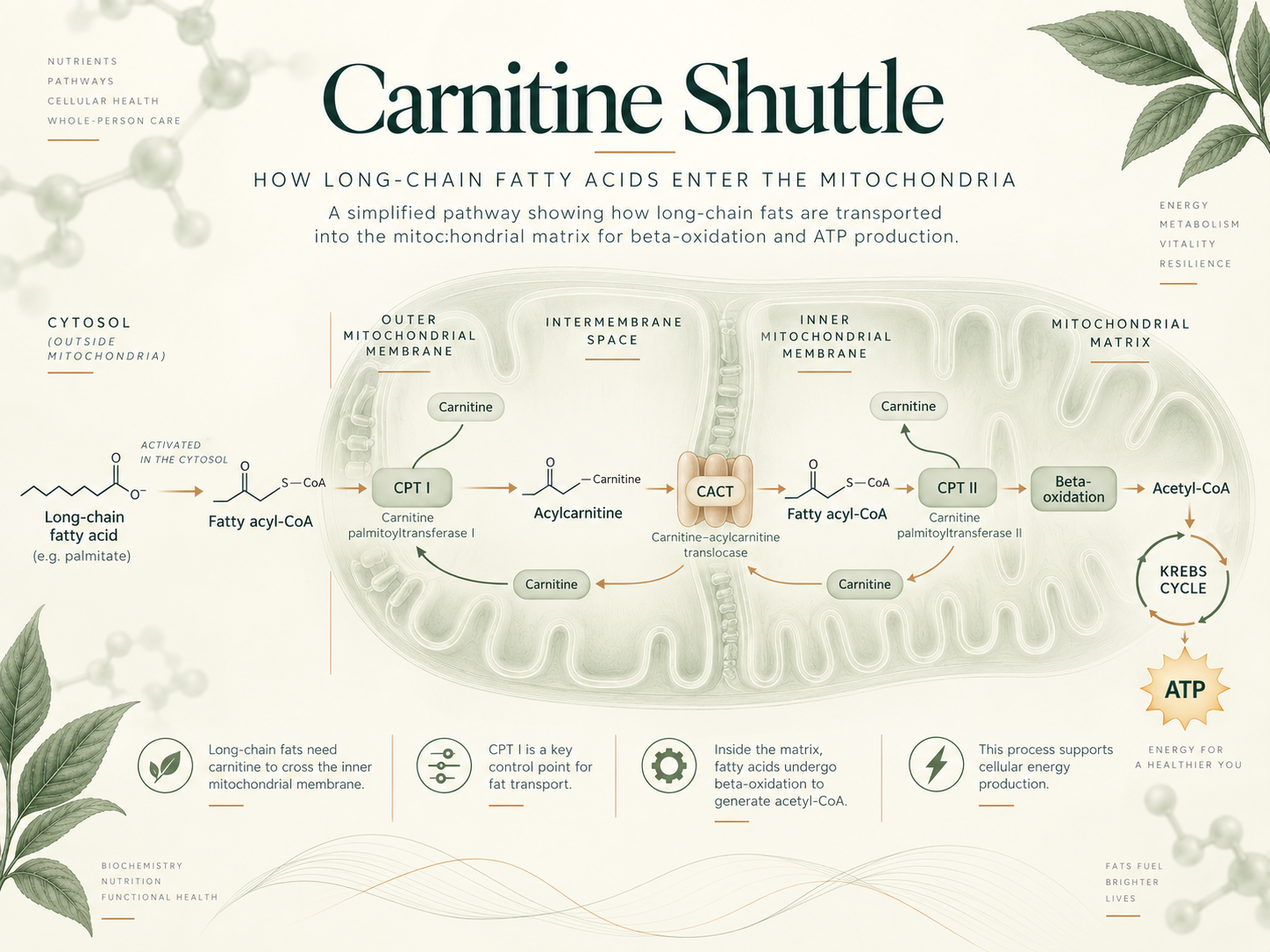
Carnitine shuttle and fatty acid transport.
Adipate
Fatty acid oxidation
What an elevation may suggest
Fatty acids are not being oxidized efficiently.
Nutrients / cofactors to consider
L-carnitine; riboflavin (B2); L-lysine when lysine is low
Suberate
Fatty acid oxidation
What an elevation may suggest
Fatty acids are not being oxidized efficiently.
Nutrients / cofactors to consider
L-carnitine; riboflavin (B2); L-lysine when lysine is low
Ethylmalonate
Fatty acid oxidation
What an elevation may suggest
Fatty acids are not being oxidized efficiently. Inherited fatty acid oxidation disorders are a separate consideration that calls for its own evaluation.
Nutrients / cofactors to consider
L-carnitine; riboflavin (B2); L-lysine when lysine is low
Pathways to Consider
Carnitine & Mitochondrial Fatty Acid Transport
Carnitine carries fatty acids into the mitochondria so they can be oxidized for energy. When fatty acid oxidation markers are elevated, carnitine status is one of the first relationships to consider, along with lysine when lysine is low.
In multiple acyl-CoA dehydrogenase deficiency (MADD), carnitine requirements may be considerably higher than usual.
Riboflavin (B2) & Its Activated Form
Riboflavin is a key cofactor in fatty acid oxidation.
Some individuals have difficulty activating riboflavin. In that situation, riboflavin-5-phosphate (R5P), the activated form, becomes the relevant consideration.
Section 3
Neurotransmitter & Catecholamine Considerations
Catecholamine and neurotransmitter metabolism is influenced by vitamin and mineral cofactors, methylation capacity, amino acid supply, and stress physiology. When neurotransmitter-related markers look out of balance, these are the relationships worth reviewing.
Vitamin B6 / P5P
Cofactor
Available as pyridoxine or as pyridoxal-5-phosphate (P5P), the active form. Vitamin B6 is also one of the methylation factors listed below.
BH4 (Tetrahydrobiopterin)
Cofactor recycling
BH2 is recycled back to BH4 with the help of Vitamin B3. Royal jelly is also listed as a BH4-related consideration.
Copper, Iron & Magnesium
Trace minerals
Patterns that may point toward trace mineral needs:
- Poor digestion
- Dysbiosis (possibly with high tricarballylate)
- High HVA/VMA ratio
- High succinic acid
- Anemia pattern on conventional labs
Vitamin C
Ascorbic acid
Especially relevant when the OAT shows patterns of high oxidative stress.
Methylation
Methylation factors
Vitamin B6 (P5P), folate (methylfolate), Vitamin B12, magnesium, and other methylation factors.
SAMe
SAH → SAM
Relates to the conversion of SAH to SAM. Listed as relevant with PNMT SNPs and with depression.
BCAAs
Leucine · Isoleucine · Valine
Branched-chain amino acids can block uptake of the amino acid precursors to dopamine and norepinephrine, which is why they come up in the context of anxiety.
Free-Form Amino Acids
Balanced formula
Relevant when amino acid precursors are low, as seen in hypometabolic states.
Stress Physiology
Cortisol · Histamine
High cortisol and histamine can shape the neurotransmitter picture. Stress-reduction approaches include sleep hygiene and limbic retraining programs (such as DNRS or the Gupta Program).
These are educational considerations for understanding catecholamine and neurotransmitter metabolism, not a treatment protocol.
Section 4
Carbohydrate & Energy Metabolism
Pyruvate, lactate, and β-hydroxybutyrate sit at the crossroads of carbohydrate metabolism, aerobic versus anaerobic energy production, and mitochondrial function.
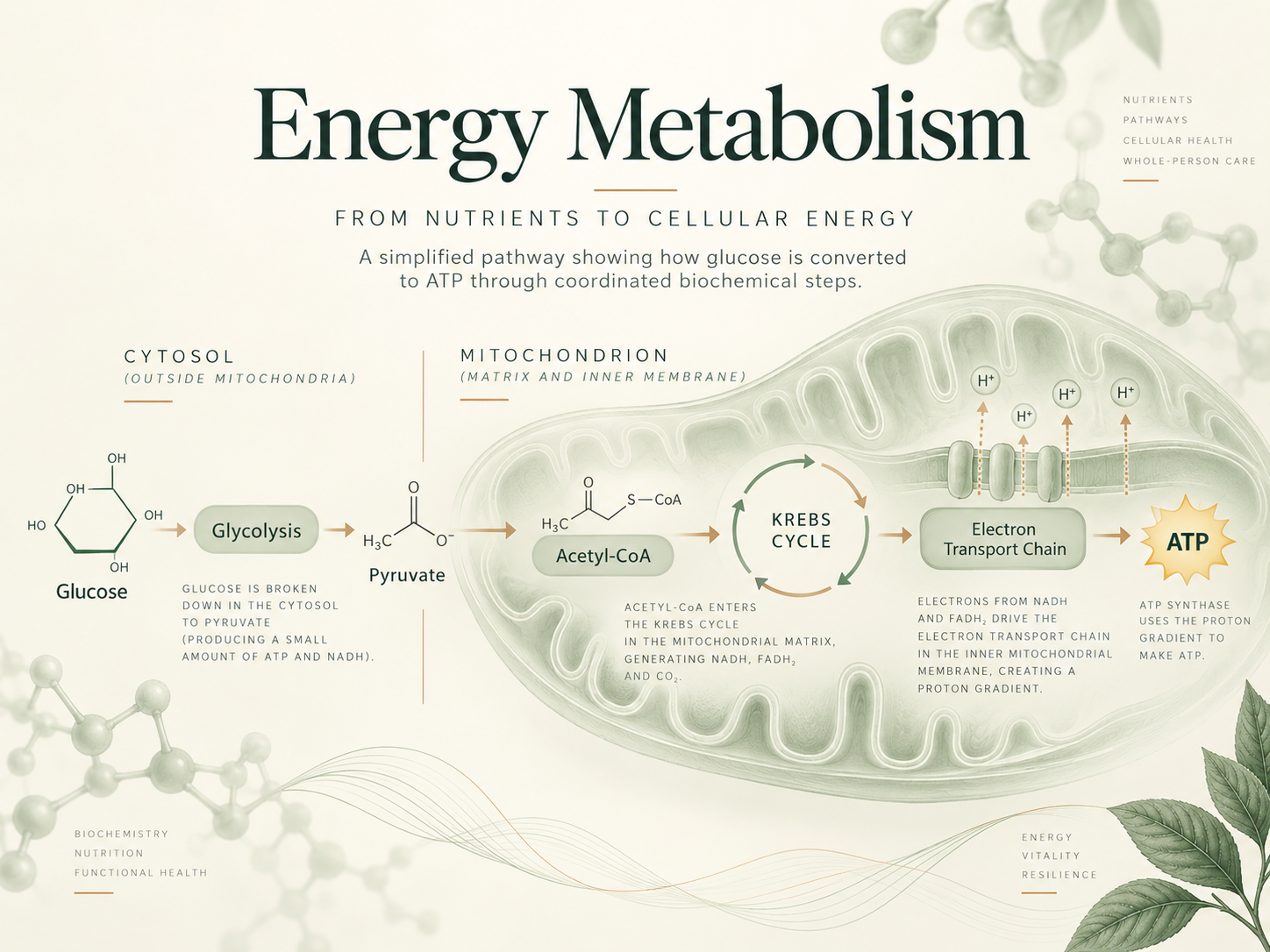
Energy metabolism pathway overview.
Pyruvate
Aerobic / anaerobic energy production
What an elevation may suggest
Pyruvate is not moving efficiently into aerobic energy production.
Nutrients / cofactors to consider
Thiamine (B1) along with B-complex support. When lactate is also elevated: lipoic acid and pantothenic acid (B5).
Lactate
Aerobic / anaerobic energy production
What an elevation may suggest
A shift toward anaerobic energy production.
Nutrients / cofactors to consider
Coenzyme Q10
Other factors to review
Dietary carbohydrate load
β-Hydroxybutyrate
Fat & carbohydrate balance
What an elevation may suggest
A shift in the balance between fat and carbohydrate metabolism.
Nutrients / cofactors to consider
Chromium; vanadium
Read these as a pattern
These markers are best interpreted together rather than individually. A high pyruvate alongside a high lactate tells a different story than either one alone, and it changes which cofactors are worth considering.
Section 5
Detoxification, Methylation & Glutathione
These markers connect to hepatic conjugation, ammonia clearance, pyrimidine synthesis, methylation, glutathione synthesis and status, and renal amino acid recovery.
2-Methylhippurate
Hepatic conjugation
What an elevation may suggest
Xylene exposure being cleared through hepatic conjugation.
Nutrients / cofactors to consider
Glycine; B vitamins. Identifying and reducing the xylene source is part of the picture.
Orotate
Ammonia clearance · Pyrimidine synthesis
What an elevation may suggest
Increased demand on ammonia clearance and the pyrimidine synthesis pathway.
Nutrients / cofactors to consider
Arginine; alpha-ketoglutarate (AKG); aspartic acid; magnesium
Homocysteine
Methylation
What an elevation may suggest
Reduced methylation capacity.
Nutrients / cofactors to consider
Vitamin B6; Vitamin B12; folate; betaine
α-Hydroxybutyrate
Hepatic glutathione synthesis
What an elevation may suggest
Increased demand on hepatic glutathione (GSH) synthesis.
Nutrients / cofactors to consider
N-acetylcysteine (NAC)
Pyroglutamate
Renal amino acid recovery
What an elevation may suggest
Altered glutathione status affecting renal amino acid recovery.
Nutrients / cofactors to consider
Glutathione
GGT
Renal amino acid recovery
What an elevation may suggest
Increased activity in the renal amino acid recovery pathway.
Nutrients / cofactors to consider
Taurine
Section 6
Gut Dysbiosis & Digestive Function
When microbial markers point toward dysbiosis, several factors may influence gut microbial balance. None of these is a universal answer. They are considerations to weigh alongside the full OAT picture and the individual in front of you.
Elimination Diets
Approaches such as AIP, low-FODMAP, and anti-Candida diets.
Fasting is another way microbial populations in the gut can be reduced, but it is not appropriate for everyone and is one option among several.
Meal Timing & Mindful Eating
Regular mealtime habits and mindful eating.
Polyphenols
Polyphenols are listed among the factors that may influence gut microbial balance.
Digestive Function
Digestive enzymes, bile acids, and gastric acid all shape the environment the gut microbes live in.
Stress Reduction
Lowering the stress response, including cortisol, is part of supporting microbial balance.
Section 7
How to Use This Guide
Do not interpret one Organic Acids marker in isolation. Look for patterns across pathways.
A marker may be influenced by nutrient status, enzyme activity, mitochondrial function, microbial activity, detoxification demand, diet, medication exposure, and overall metabolic state.
The goal is not simply to identify what is high or low, but to ask:
- What pathway is this marker part of?
- What comes before it?
- What comes after it?
- Which cofactors are required?
- Are related markers moving in the same direction?
Educational use only. This guide is intended for education and is not medical advice, a diagnosis, or a treatment protocol. OAT findings should be interpreted by a qualified practitioner in the context of the whole person.
Marker and pathway relationships adapted from Lord, R. S., & Bralley, J. A. (2012). Laboratory Evaluations for Integrative and Functional Medicine (Revised 2nd ed.). Duluth, GA: Metametrix Institute.
Keep Learning